Sunday, 05 February 2012    HomeAbout UsContact Us     


You are here: Home / Sayyid Qutb
Did Sayyid Qutb Repent From Abusing and Attacking the Companions? Refuting the Intellectual Fraud of the Extremist Qutbiyyah - Part 3
Filed under: Sayyid Qutb
Saturday, January 30 2010 - by Admin
Key topics: Al-Adaalah Al-Ijtimaa'iyyah Social Justice The Companions

Bookmark and Share

Mail to a FriendPrinter friendly

Understanding the Propensity of the Extremist Qutbiyyah in Defending Falsehood

The Qutbiyyah are claiming that Sayyid Qutb repented from his attacks upon the Sahaabah, which is an empty claim, devoid of evidences, and the reason why this claim is fraudulent and cannot be sustained is because Qutb's attacks upon the Companions Uthmaan, Mu'awiyah, Amr bin al-Aas and the Bani Umayyah were from an ideological conviction derived from the notion of "Social Justice", which came from his Marxist-Socialist-Communist background. So they have no proof unless they bring something that meets the guidelines of a proper repentance (see below).

To learn more about this ideological conviction of Sayyid Qutb, refer to the following articles:

Requirements of a True Repentance

Qutb's response to Mahmood Shakir and his persistence upon his ideological conviction regarding those Companions proves that Qutb did not change, and he did not remove the malice in his heart. Further, if the Qutbiyyah are claiming he repented, then altering some words does not constitute repentance, rather a true repentance is characterized in:

  • Immediate cessation of the act
  • Feeling of remorse
  • Resolve not to do it again
  • And where it involves the right of others (i.e. Uthman, Mu'awiyah, Amr bin al-Aas), then their right has to be returned, and their honors exonerated, with a refutation of and recantation from one's transgression
  • And verbally seeking forgiveness from Allaah, and repenting to Him.

That's a sign of a true repentance. We will give the Qutbiyyah three years from today's date, 29th January 2010 to provide us with this Sharee'ah repentance that is ascribed to Sayyid Qutb from his attacks against the Companions.

Part 3: Third Example of Change in Wording

In the 5th edition of "al-Adaalah al-Ijtimaa'iyyah fil-Islaam" (Social Justice in Islaam), Qutb said on page 186 of the 5th edition:

هذا التصوّر لحقيقة الحكم قد تغيّر شيئـًا ما بدون شك على عهد عثمان ، ولقد كان من سوء الطالع : أن تدرك الخلافة عثمان وهو شيخٌ كبير ، ضعفت عزيمته عن عزائم الإسلام ، وضعفت إرادته عن الصمود لكيد مروان وكيد أمية من ورائه .

فهم عثمان ـ يرحمه الله ـ أنّ كونه إمامـًا يمنحه حريّة التصرّف في مال المسلمين بالهبة والعطية؛ فكان رده في كثير من الأحيان على منتقديه في هذه السياسة : <<وإلاّ ففيم كنت إمامـًا ؟>> كما يمنحه حرية أن يحمل بني معيط وبني أمية ـ من قرابته ـ على رقاب الناس ، وفيهم الحكم طريد رسول الله لمجرّد أنّ من حقه أن يكرم أهله ويبرهم ويرعاهم

This conception of the reality of rulership changed somewhat without any doubt in the era of Uthmaan, and it was from ill-fortune (i.e. unfortunately): That the khilaafah reached Uthmaan whilst he was on old man, his determination had weakened (away) from the resolutions of Islaam, and his desire to stall the plot of Marwan and the plot of [Bani Umayyah] from behind it.
Uthmaan thought - may Allaah show mercy to him - that his being an Imaam conferred upon him the freedom to spend (liberally) from the wealth of the Muslims through gifts and presents, and his response on many occasions to those criticising him in this political [orientation] was "If not then for what [purpose] am I the Imaam?". Just like [he thought] it conferred him the freedom to carry Bani Mu'eet and Bani Umayyah - from his relatives - upon the shoulders of the people, and amongst them is al-Hakam [bin al-Aas], the one outcast [by] the Messenger of Allaah, [doing all of this] for the mere [reason] that [he thought] it was his right to be generous to his family, to be benevolent to them and to look after them.

This is what he said in the 5th edition.

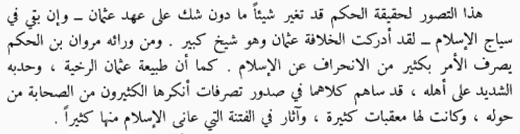
In the book "al-Adaalah al-Ijtimaa'iyyah" (1993CE/1413H, Dar ash-Shurooq), there is a small introduction (p. 5) by Sayyid Qutb, which is signed and dated March 1954CE, and in this edition there were some changes in wording. It should be noted that the last edition before Qutb's death was the 6th edition, and that is the one that has continued to be reprinted as further editions. We have with us the 13th edition at this point in time.

Qutb writes (p. 159) in this 13th edition:

This conception of the reality of rulership changed somewhat without any doubt in the era of Uthmaan - even if it remained within the enclosure of Islaam - for the khilaafah reached Uthmaan whilst he was an old man. And behind him was Marwan bin al-Hakam who would turn the affair by a great deal to be of deviation from Islaam. Just as the nature of Uthmaan was very lax, [in addition to] his severe affection for his family. Both of them participated in giving rise to dealings which many of the Companions around them rejected, and [these dealings] had many consequences and effects in the tribulation from which Islam suffered greatly.

As you can see, the meaning is left intact, Qutb has not changed his ideological conviction, he's just changed the words, whilst keeping the same insults, slurs and revilement. And then immediately after this revised statement he says the following about Uthmaan (radiallaahu anhu), Mu'awiyah and Bani Umayyah - all of which makes clear that he is persisting upon his ideological conviction based upon the notion of (Communist) "Social Justice" which he used to attack Capitalism (the use of "capital" to maintain class supremacy) taking all of this from secular atheist Jews like Marx, Engels and Lenin, those Materialist Western Philosophies he was drinking from between 1925 to 1940 (see here) - so he says:

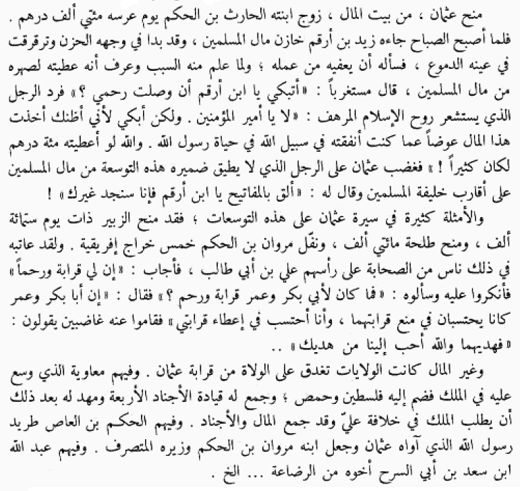
In the above lengthy quote Qutb, continuing directly from where he previously left off alluding to those activities of Uthmaan and Marwan bin al-Hakam (radiallaahu anhumaa) that "Islam suffered from greatly":

Uthman conferred, from the Bayt ul-Mal, the husband of his daughter, al-Harith bin al-Hakam, on the day of the wedding, 200,000 dirhams and then when the morning arrived, Zaid bin Arqam, the treasurer of the wealth of the Muslims came [to Uthmaan], sadness had appeared on his face and tears started rolling from his eyes, and so he asked him (Uthmaan) to pardon him for his action (i.e. for the loss of that wealh from the bayt ul-maal). When he (Uthmaan) came to know the reason (for Zayd's sadness), and he (Uthman) recognized that he gave to his son-in-law from the wealth of the Muslims, he said, in surprise (to Zayd), "Are you crying O son of Arqam because I tied my ties of kinship?" Then the man (i.e. Zayd) who perceived (felt) the very sharp spirit of Islam replied, "No O Chief of the Believers. However I am crying because I thought you had taken this wealth as compensation for what you used to spend in the path of Allaah in the life of the Messenger of Allaah. By Allaah, if you had given him one hundred dirhams it would have been enough!" So then Uthmaan became angry against the man whose concsience could not accept this liberty regarding the wealth of the Muslims upon the close-relations of the the khalifah of the Muslims, and so he said to him, "Give me the keys O son of Arqam, for we will find another (treasurer) besides you"!

It is hard for the writer of these lines to even translate this filth from Sayyid Qutb, this is extremely disgusting and vile, and this is supposed to be a so-called post-repentance publication after Mahmood Shakir's refutation of him.

And the examples with respect to such liberties are many in the seerah (biography) of Uthmaan. For he had conferred upon az-Zubair 600,000 one day, and he conferred upon Talhah 200,000, and he granted Marwan bin al-Hakam a fifth of the African land-tax. And some people from the Companions scolded him for that, at the head of them, Alee bin Abee Taalib, and so he (Uthmaan) replied, "I have relatives and ties of kinship", and they rejected that against him and asked him, "Did not Abu Bakr and Umar have reletives and ties of kinship?", so he (Uthmaan) replied, "Abu Bakr and Umar used to anticipate (reward) in preventing from their relatives, and I anticipate (reward) in conferring upon my relatives." So they stood and turned away from him in anger, saying, "Then their guidance is more beloved to us than your guidance".

This is worse filth than before and where is he getting these narrations from without any references or sources or chains of narration?

And besides wealth, the [land] provinces were showered upon the rulers from the relatives of Uthmaan, and amongst them was Mu'aawiyah towards whom [Uthmaan] was copious in granting him dominion, so he gave him Palestine and Hims, and also brought together for him the leadership of the four armies, and after that he (Uthmaan) also paved the way for him to seek dominion in the khilaafah of Alee, and he (Mu'awiyah) had gathered wealth and armies, and amongst them was al-Hakam bin al-Aas, the [one] outcast by the Messenger of Allaah, Uthmaan sheltered him and made his son, Marwan bin al-Hakam the provincial governor, and amongst them was Abdullah bin Sa'd bin Abi as-Sarh, his brother through fostering... and so on..."

These attacks you are seeing against Uthmaan, Mu'aawiyah and Bani Umayyah are just the wrath of a Communist Socialist Marxist mind being unleashed upon "Capitalists" represented in those holding the wealth (Bayt ul-Maal) and "abusing it to maintain their power and class supremacy". It's the typical Marxist discourse.

To learn more about the ideological background of Sayyid Qutb refer to the following articles:

We will repeat here what we said previously, as the observations are the same, which is that when we look at these apparent changes Qutb was supposed to have made to the 1954 edition of this book following Mahmood Shakir's refutations against Qutb in a series of five articles two years previously in 1952, you have to really understand what is going on here and what Qutb's stance is, and it is:

That pesky Mahmood Shakir with impure intentions and a desire to create fitnah is attacking my defense of Islam against the inexcusable errors of the likes of Uthmaan, Mu'awiyah, Marwan (bin al-Hakam) Amr bin al-Aas and those evil Bani Umayyah - he's written all those articles attacking me and my books (see here). So I'm going to remove those words such as "senile, decrepit" and "debilitated..." to avoid such criticism in the future, whilst maintaining my ideological conviction regarding Uthmaan and Mu'awiyah and Marwan and Bani Umayyah, continuing to express it. Because I see this as a defense of the spirit of Islam and a defense of Islam from its enemies (capitalist West), and this is in conformity with my fikr of presenting the notion of "Social Justice" (an alternative to using the word "Communism" or "Socialism") in Islam and thus, Islam's battle against "Capitalism" (the misuse of wealth for private monopoly and maintenance of class struggle). So ideologically, I ain't changing one bit, and I'm holding on to my position and perception, but I'll just be careful with my words so that those "fitnah-mongers" don't cause any more problems.

That is very accurately, what you have going on here in a nutshell - and we will publish Qutb's response to Mahmood Shakir in a separate article.

Mahmood Shakir's Amazingly Insightful Remark

These attacks from Qutb were from an ideological conviction and Mahmood Shakir could not have said it better in 1952 in his refutation of Qutb (see here) wherein he stated:

ولن أضرب المثل بما يكتبه المستشرقون ومن لف لفهم؛ فهم كما نعلم ، ولا بأهل الزيغ والضلال والضغينة على أهل الإسلام؛ كصاحب كتاب (الفتنة الكبرى) وأشباهه من المؤلفين بل سآتيك بالمثل من كلام بعض المتحمسين لدين ربهم ، المعلنين بالذب عنه والجهاد في سبيله ، وأن سمة الحضارة الوثنية الأوروبية ، تنفجر أحياناً - في قلب من لم يحذر ولم يتق - بكل ضغائن القرن العشرين ، وبأسوأ سخائم هذه الحضارة المعتدية لحدود الله ، التي كتب على عباده - مسلمهم وكفارهم - أن لا يتعدوه. أربعة من أصحاب رسول الله (صلى الله عليه وسلم) ، هم : أبو سفيان بن حرب ، ومعاوية بن أبي سفيان ، وعمرو بن العاص ، وهند بنت عتبة بن ربيعة ؛ أم معاوية ، رضي الله عنهم ، كيف يتكلم أحد الناس عنهم ؟!

And I am not going to give an example of what the Orientalists, and those of the same sort as them, for they are as we already know (of them), and nor (will I give an example) of the people of deviation, misguidance and malice against the people of Islaam, such as the author of the book "al-Fitnah al-Kubraa" and his likes amongst the authors.

Rather, I will bring you the example from the speech of one of the sentimentalists towards the deen of their Lord, who proclaim defence of it and [proclaim] making jihaad in its path, [and show] that the quality of the idolatrous western civilization manifests itself, explosively - in the heart of the one who does not beware and take caution - with all of the malices of the twentieth century and with the most evil of resentments of this civilization that transgress the limits of Allaah. [those] which He prescribed upon His servants - Muslims and non-Muslims - that they should not transgress. [This transgression being against] four from the Companions of Allaah's Messenger (sallallaahu alayhi wasallam), they are Abu Sufyaan bin Harb, Mu'aawiyah bin Abi Sufyaan, Amr bin al-Aas and Hind bint Utbah bin Rabee'ah, the mother of Mu'aawiyah (radiallaahu anhum) - how one of the people [Qutb] has spoken about them?!

Mahmood Shakir is saying here that the hatred of the Orientalists and their likes, and the people of innovation, desires and misguidance is known towards the Islam and its people, and so there is no need to give examples of their hatred, but rather, that he will give an example of a sentimentalist towards Islam, who proclaims its defence, and in whom there is found the violent explosive expression of all of the malice and hatred of the idolatrous western civilization that transgress those limits of Allaah that He ordered not to be transgressed. And that this malice and hatred manifested itself against four of the Companions of Allaah's Messenger (alayhis salaam).

Summary

It is one thing to say Qutb was in error and lets move on, but it is entirely another thing to claim Qutb recanted from his attacks upon the Companions (with a proper Sharee'ah repentance), and all we have are empty claims with no explicit proof.


Link to this article:   Show: HTML LinkFull LinkShort Link
Related Articles:
Add a Comment (comments are currently moderated)
You must be registered and logged in to comment.


The Sayings, Verdicts and Rulings of the Scholars of Ahl us-Sunnah Regarding the Doctrines and Books of Sayyid Qutb (21)
Concerning Shaykh Ibn Jibreen's Defence of Hasan al-Banna and Sayyid Qutb (6)
Misguiding the Ummah Through Propaganda For Qutb's Books: An Encyclopedia of the Innovations and Deviations They Contain (13)
The False Comparison Between Hadith Giants Ibn Hajar, an-Nawawi and 20th Century Ignoramuses (2)
Sayyid Qutb and the Aqidah of the Rafidah in Reviling and Abusing the Companions (7)
Sayyid Qutb and the Issue of the Doctrine of 'Wahdat ul-Wujood' (4)
Bayan Talbis al-Qutbiyyah - Explanation of the Deception of the Qutbiyyah (4)
Qutbi Competition Corner - Test Your Aptitude for Defending Baatil (1)
Hasan al-Banna, al-Ikhwan and the Rafidite Shiah (3)
Latest Articles
The Relationship Between Shaykh Rabee al-Madkhali and the Major Scholars: Part 4 - Shaykh Salih al-Luhaydaan's Praise of Shaykh Rabee 1433H
Shaykh al-Fawzan Defends Imaams Ibn Baz and Ibn Uthaymin From the Accusation of Irjaa'
Sayyid Qutb and Mohammad Qutb Were Asharis
Shaykh al-Albani, Shaykh Ibn Uthaymin, Shart Kamal and Shart Sihhah, Irjaa and the Gormless Hawalian Qutbis
Sayyid Qutb and Cultivation Upon Sufism, Tasawwuf and Its Works: Part 2
Sayyid Qutb and Cultivation Upon Sufism, Tasawwuf and Its Works: Part 1
Sayyid Qutb, the Revolution Against the Caliph Uthmaan and the Revolution of the Baatiniyyah Raafidah Qaraamitah
The Prophetic Hadeeth in Refutation of Sayyid Qutb's Secularist, Marxist Communist Principles
Defending and Exonerating Islam From Sayyid Qutb's Islamo-Communism
Did Sayyid Qutb Repent From Abusing and Attacking the Companions? Refuting the Intellectual Fraud of the Extremist Qutbiyyah - Part 4
Search This Site

 Other Websites
 Takfiris.Com

Most Popular
A Picture Paints (Characterizes) a Thousand Qutbis: Hasan al-Banna, Sayyid Qutb, Abu A'la Mawdudi, the Rafidah and the Iranian Revolution
Readings in Elementary Communism: Karl Marx, Freidrich Engels, Sayyid Qutb, Capitalism, the State, Social Justice, Revolution and the Communist Manifesto
Sayyid Qutb and the Revolution Organized in Egypt Against the Third Khalifah Uthman bin Affaan
Shaykh Muhammad bin Saalih al-Uthaymeen Distinguished Between The Salafi Manhaj and The Qutbi Manhaj and Wholeheartedly Reccommended Warning From the Qutbi Manhaj After Detailed Study and Consideration
Sayyid Qutb and the Aqidah of the Raafidah: Part 1 - Mahmood Shakir's Defence of the Companions Against the Attacks of Sayyid Qutb - First Installment - Introduction
Bayan Talbis al-Qutbiyyah: Part 3 - The Allegation that Shaykh Rabee' Made Takfeer of Shaykh Ibn Jibreen
The Words of Imaam Ibn Baz Falling on Those (Qutbiyyah) Who Lied Upon Him (Safar al-Hawali, Salman al-Awdah, Muhammad Sa'eed al-Qahtani, Aa'id al-Qarnee, Abdur-Razzaq ash-Shayijee): Callers of Falsehood and Stirrers of the Murky Waters
Salman al-Awdah, Aa'id al-Qarnee, Habib Ali al-Jifree and Amr Khalid: The Ikhwani Bannaawi Manhaj in Practice
Shaykh Rabee's Permission to Narrate Hadeeth from Allaamah Ubaydullaah al-Mubarakfuri Whose Sanad Connects to the Sanad of the Imaams of Hadeeth
Impaling Leninist Qutbi Doubts: Shaykh Ibn Jibreen Makes Takfir Upon (Declares as Kufr) the Saying of Sayyid Qutb That Islam Is a Mixture of Communism and Christianity

Tags
aa'id al-qarnee aa'id al-qarni abbaas al- abbas el-akkad abd al-aziz aal ash-shaikh abdul-aziz aal ash-shaikh abdul-aziz ar-raajihee abdullah azzam abdullah bin saba' abdur-razzaq ash-shayijee abu a'la mawdudi abu sufyan ahmad shakir al-adaalah al-ijtimaa'iyyah al-arsh albaanee albani alexis carrel al-fawzaan al-fawzan algeria al-ghazali al-ghudayan al-istiwaa al-luhaidan al-mubarakfuri al-uluww amr khalid an-nawawi aqidah aqqaad ar-razi ash'ari asharis ash'aris ash'arite ash'ariyyah asha'riyyah az-zilal banna barbarism bayaan talbis al-qutbiyyah bayan talbis al-qutbiyyah christianity communism communist manifesto egypt excommunication extremism faith fawzan fi zilal il-quran fi zilal il-qur'an fikr frederick engels george bush ghaddafi ghuluww grave worship haakimiyyah habib ali al-jifree hadd hammad al-ansari hasan al-banna hayyiz hind hudood ibn arabi ibn baaz ibn baz ibn hajar al-asqalani ibn hajr ibn jibreen ibn jibrin ibn saba al-yahudi ibn taymiyyah ibn uthaymeen ibn uthaymin imaan in the shade of the qur'an iranian revolution irja irjaa irjaa' istibdaal istihzaa jaahiliyyah jahmiyyah jamaa'at ut-takfir jameel zainoo jihah karl marx khabar ul-aahaad khabar ul-wahid khameni kharijites khawarij khomeini khurooj kufr bawah leninism leninists libya madkhali madkhalis mahmood shakir mahmud shakir makaan makhlooq marxism marxist socialism mawdudi milestones mockery mohammad qutb mongols moosaa moses mu'awiyah mufawwidah mufawwidh muhammad bin ibraaheem muhammad bin ibrahim muhammad sa'eed al-qahtani muqbil bin haadee muqbil bin hadi murji'ah nawawi qawaaneen qawanin qur'an qutb qutbi qutbi manhaj qutbis qutbiyyah qutubiyyah raafidah rabi al-madkhali rabi bin hadi al-madkhali rafidah rafidah shi'ah revolutionary ideology safar al-hawali sahaabah salafi manhaj salih aal ash-shaykh salih al-luhaydan salman al-aqdah salman al-awdah saudi saudi arabia sayyid qutb secular law secular laws secularism shaikh rabi shanqeetee shanqiti shaykh abd al-aziz aal ash-shaykh shaykh abd al-aziz bin baz shaykh abdul-aziz bin baz shaykh al-albani shaykh al-luhaydaan shaykh al-uthaymin shaykh ibn jibrin shaykh ibn uthaymin shaykh muqbil bin haadee shaykh muqbil bin hadi shaykh rabee shaykh rabee' shaykh rabee bin haadee shaykh rabi shaykh rabi al-madkali shaykh rabi bin hadi al-madkhali shiah shi'ites shirk sifaat fi'liyyah social justice socialism soofee speech of allaah sufi sufism syria tabdeel tafweed tahkeem tahkeem al-qawaaneen tahkim al-qawanin takfeer takfir takfiris takhyeel tashree' taswir al-fanni fil-qur'an tatars ta'weel tawhid tawhid al-haakimiyyah tawhid al-hakimiyyah tawhid al-hukm the companions ubaydullah al-mubarakfuri wahdat ul-wujood zilal

Archives
February 2012
January 2012
December 2011
November 2011
October 2011
September 2011
August 2011
July 2011
June 2011
May 2011
April 2011
March 2011
February 2011
January 2011
December 2010
November 2010
October 2010
September 2010
August 2010
July 2010
June 2010
May 2010
April 2010
March 2010
February 2010
January 2010
December 2009


© TheMadkhalis.Com. All rights reserved.
Madkhalis Madaakhilah The Madkhalis